Saturday, July 28, 2012

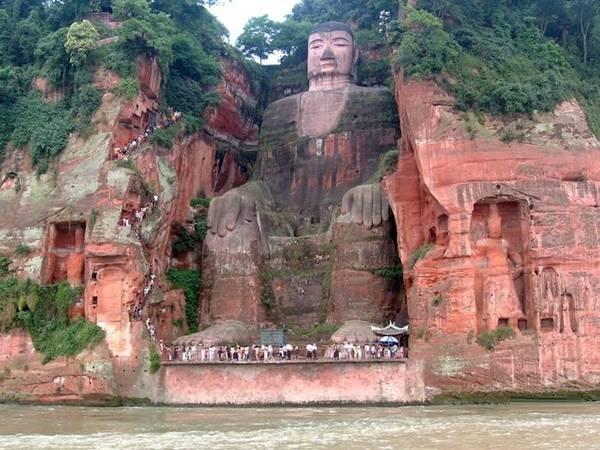
Leshan Giant Buddha


 The Leshan Giant Buddha (simplified Chinese: Lèsha-n Dàfó) was built during the Tang Dynasty (618–907AD). It is carved out of a cliff face that lies at the confluence of the Minjiang, Dadu and Qingyi rivers in the southern part of Sichuan province in China, near the city of Leshan. The stone sculpture faces Mount Emei, with the rivers flowing below his feet. It is the largest carved stone Buddha in the world and it is by far the tallest pre-modern statue in the world. The Mount Emei Scenic Area, including Leshan Giant Buddha Scenic Area has been listed as a UNESCO World Heritage Site since 1996. It was not damaged by the 2008 Sichuan earthquake.


History

Construction was started in 713, led by a Chinese monk named Haitong. He hoped that the Buddha would calm the turbulent waters that plagued the shipping vessels traveling down the river. When funding for the project was threatened, he is said to have gouged out his own eyes to show his piety and sincerity. After his death, however, the construction was stuck due to insufficient funding. About 70 years later, a jiedushi decided to sponsor the project and the construction was completed by Haitong's disciples in 803.

Apparently the massive construction resulted in so much stone being removed from the cliff face and deposited into the river below that the currents were indeed altered by the statue, making the waters safe for passing ships.


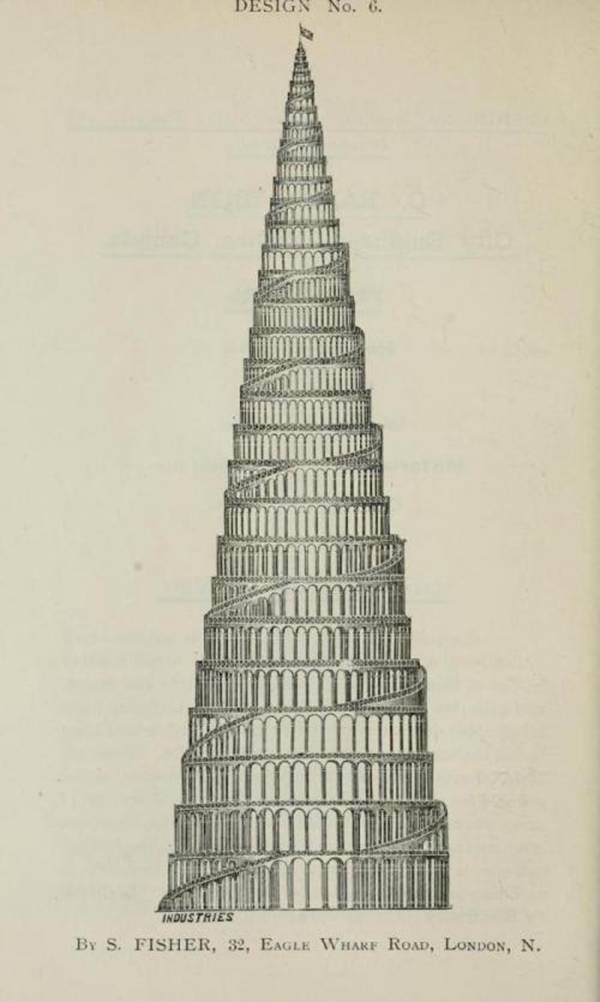
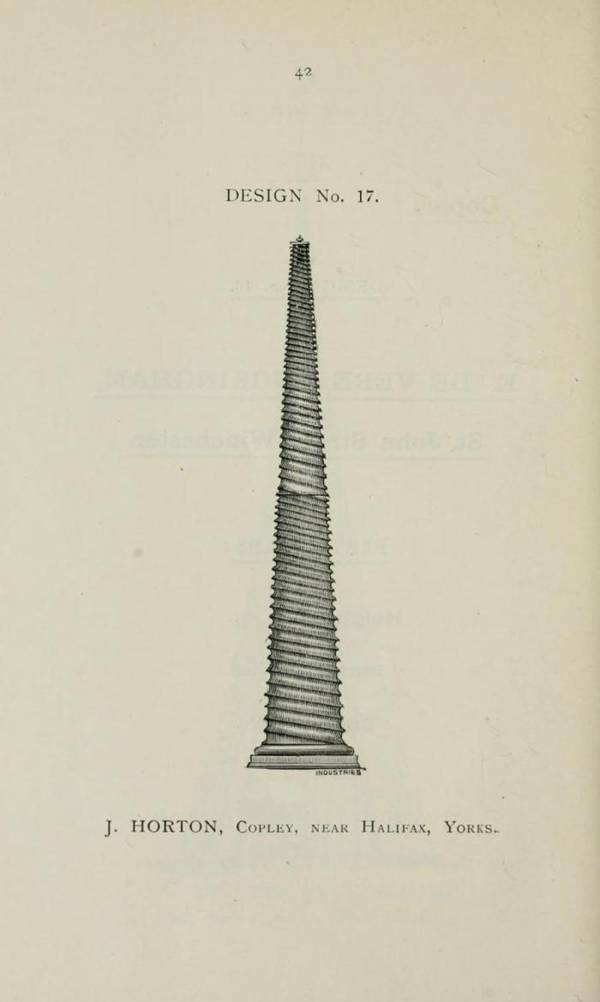
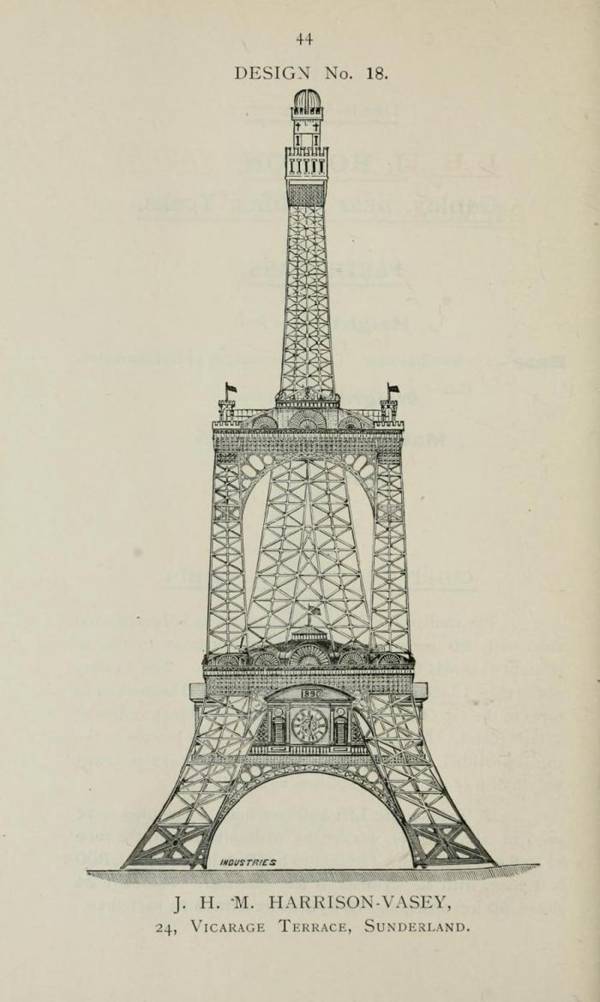
Amazing Tower Design of English Project

The English held a contest to design London’s wacky rip-off of the Eiffel Tower — Inspired by the financial success of the Eiffel Tower — which was erected in Paris for the 1889 World's Fair — a group of Englishmen attempted to bang out their own ersatz Eiffel a year later. This contest to design the never-to-be "Great Tower of London" received 68 designs. Some resemble alien fortresses and all of them would've (supposedly) prompted an international Eiffel Tower arms race. To quote:


Taking into consideration the enormous popularity of the Eiffel Tower and the consequent pecuniary benefits conferred on those interested in that undertaking, it is not too much to anticipate that, in the course of a short time, every important country will possess its tall Tower. The project of erecting a great Tower in London soon found the willing support of many capitalists, who felt convinced that if the scheme were properly laid before the public there would be no great difficulty in accomplishing the object. 
 

The pamphlet further elaborated that "the high land between Willesden and Harrow at Wembly Park, has been selected (subject to further consideration)" as a location for this tower. You can see the first two winners — which top out at 1,200 and 1,300 feet, respectively — below, along with some of the zanier proposals. I'm particularly partial to the upside-down screw that is the "Century Tower."


Famous Sea Stacks From Around the World

A stack or sea stack is a rock formation made up of a steep or upright column or columns of rock in the sea near a coast. They are formed when part of a headland is eroded by water crashing against the rock or as a result of wind erosion. These impressive formations are intricately created by nature only through time, tide and wind. Here are 10 famous sea stack formations from around the World.

01. Dun Briste, Ireland

 Dun Briste, a spectacular sea-stack, estimated to be approximately 50 metres (165ft) in height, stands 80 metres (260ft) off Downpatrick Head, in the town-land of Knockaun, east of Ballycastle, Ireland. Downpatrick Head is where the Atlantic has gouged a huge bay from the mighty cliffs and their summits scoured of all vegetation except grass by the ceaseless ocean winds.


Each year, Downpatrick is frequented by birdwatchers, who come to observe and record the many different species which take up positions on the stratified face of the stack as the seasons change. In May and early June, the headland itself is a blaze of colour when the sea-pink comes into bloom.

02. Sail Rock, Russia


Sail Rock is a natural sandstone monolith located on the shore of the Black Sea, in Krasnodar Krai, Russia. It resembles the outline of a ship’s sail, hence its name. The monolith lies 17 km (10.5mi) to the southeast of Gelendzhik, near the village of Praskoveyevka (which is about 500 meters (1,650ft) from the coast) and the farmstead of Dzhankhot (approximately twice that distance from the coast).


Sail Rock has a sheer vertical slope confronting the shore of sea, isolated from the mass of basic rock by geological forces. It is more than three-fourths revealed by the tide and lies perpendicular to the coast. What is most remarkable about this landmark is its proportions. While the cliff is only a little more than a meter (3ft) thick, its height is about 25 meters (82ft) and its length about 20 (66ft). Thus, the form of the cliff is described as resembling the outline of a quadrangular sail. 

03. Old Man of Hoy, Scotland, UK

The Old Man of Hoy is a 449 feet (137m) sea stack on the island of Hoy. It is a distinctive landmark from the Thurso to Stromness ferry and was first climbed in 1966. This stack is an red sandstone stack, perched on a plinth of basalt rock. It stands close to Rackwick Bay on the west coast of the island of Hoy, in the Orkney Islands, Scotland.


The stack is probably less than 400 years old and may not get much older, as there are indications that it may soon collapse. On maps drawn between 1600 and 1750, the area appears as a headland with no sea stack. William Daniell, a landscape painter, sketched the sea stack in 1817 as a wider column with a smaller top section and an arch at the base, from which it derived its name. A print of this drawing is still available in local museums. Sometime in the early 19th century, a storm washed away one of the legs leaving it much as it is today, although erosion continues. 

04. Risin og Kellingin, Faroe Islands

Risin og Kellingin (Risin and Kellingin) are two sea stacks just off the northern coast of the island of Eysturoy in the Faroe Islands close to the town of Eiði. The name Risin og Kellingin means The Giant and the Witch and relates to an old legend about their origins. The Giant (Risin) is the 71m (233ft) stack further from the coast, and the witch (Kellingin) is the 68m (223ft) pointed stack nearer land, standing with her legs apart.


The stacks can be viewed by walking north from Eiði then turning east towards the coast and following the low cliffs for a short way. Other good views can be had on a clear day from Tjørnuvík on the island of Streymoy. Faroese geologists predict that Kellingin, which currently stands on two legs, will fall into the sea sometime in the next few decades during the winter storms. Already part of the stack broke off at the beginning of the twentieth century. 
05. Ko Tapu, Thailand

Ko Tapu is a limestone rock about 20 metres (66 ft) tall with the diameter increasing from about 4 metres (13 ft) near the water level to about 8 metres (26 ft) at the top. It lies about 40 metres (130 ft) to the west from the northern part of Khao Phing Kan (a pair of islands on the west coast of Thailand).


A scientific version of the Ko Tapu formation says that the area was a barrier reef. Then, upon tectonic movements, it ruptured, and its parts were dispersed over the area and flooded by the rising ocean. Wind, waves, water currents and tides gradually eroded the islands thus formed, sometimes producing peculiar shapes, such as Ko Tapu. Tide-related erosion is visible at the bottom of the rock.

06. Ball’s Pyramid, Australia

Ball's Pyramid is 20 kilometres (12 mi) southeast of Lord Howe Island in the Pacific Ocean. It is 562 metres (1,844 ft) high, while measuring only 1,100 metres (3,600 ft) in length and 300 metres (980 ft) across, making it the tallest volcanic stack in the world.  Ball's Pyramid is part of the Lord Howe Island Marine Park.


In 2001, a large species of insect commonly known as a tree lobster or Lord Howe Island stick insect was discovered clinging to the stack eighty years after it was believed to have gone extinct. Rats introduced to the larger islands are to blame for the six-inch insect’s demise. Scientists captured several insects to breed, which they finally did successfully, and may be introduced to the mainland.

07. Kicker Rock, Galapagos, Ecuador

Kicker Rock, also called the Sleeping Lion is a rocky formation and popular dive destination on the western side of Isla San Cristobal, the easternmost island in the Galápagos archipelago.


This gigantic rock raises 500 feet (152m) straight from the ocean and represents the remains of a lava cone, now split in two. There is a mild current that passes through the two rocks, which attracts hammerhead and Galápagos sharks. Kicker Rock is also home to a large colony of sea birds.

08. Old Harry Rocks, UK

The Old Harry Rocks are two chalk stacks located on the Dorset coast in the south of England. The rocks mark the eastern end of the Jurassic Coast. The cliffs here are mainly made up of chalk, with some bands of flint within them.


The sea stacks are continuously being eroded by the sea and are therefore an ever-changing feature. In the 18th century, people could still walk from the mainland to Old Harry, which is the stack at the end nearest to the sea. Link Map. 

09. The Twelve Apostles, Australia

The Twelve Apostles is a collection of limestone stacks off the shore of the Port Campbell National Park, by the Great Ocean Road in Victoria, Australia. Their proximity to one another has made the site a popular tourist attraction.


Tourism activities (including helicopter tours) are conducted from a visitor centre, situated on the inland side of the Great Ocean Road; with parking and viewing areas. Parks Victoria classifies the structure as nationally significant, with the area being one of Victoria's major tourist features; attracting approximately two million visitors a year. Parks Victoria was responsible for the construction of board-walks, tracks, and viewing areas.
10. Tri Brata, Russia

At the entrance of Avacha Bay lies Tri Brata, a trio of scenic stacks which is considered a symbol of Petropavlovsk-Kamchatsky, the main city of Kamchatka Krai, Russia.


The name is Russian which literally means "Three Brothers". Legend has it that three brothers who went to defend a town from a tsunami turned into pillars of stone.
Inhabited Oldest Cities in the World

Ever since man learned to grow their own food and rear cattle, they have been living in permanent to semi-permanent settlements with certain degree of planning. Although opinions vary on whether any particular ancient settlement can be considered to be a city, there is no doubt that towns and cities have a long history.

The earliest civilizations in history were established in the region known as Mesopotamia, largely corresponding to modern-day Iraq, northeastern Syria, southeastern Turkey and southwestern Iran. Archaeological remains unearthed in Mesopotamia provides proof of settlements dating back to 10,000 BC. After Mesopotamia, the city culture arose in Syria and Anatolia, as shown by the city of Çatalhöyük (7500-5700BC). Mohenjodaro of the Indus Valley Civilization in present-day Pakistan existed from about 2600 BC and was one of the largest ancient cites with a population of 50,000 or more.

While it might not be too difficult to determine which is the oldest city in the world, there is fierce contention for the title of the oldest continuously inhabited city in the world. Often the age claims are disputed and historical evidences are difficult to prove. Then there are differences in opinion as to the definitions of "city" as well as "continuously inhabited". In any case, the following cities besides being some of the ancient in the world, they continue to grow and thrive until the present day.

01. Jericho, Israel
Continuously Inhabited Since: 9000 BC

Jericho is a city located near the Jordan River in the West Bank of the Palestinian territories, capital of the Jericho Governorate and with a modest population of around 20,000. Situated well below sea level Jericho is believed to be the oldest continuously inhabited city in the world.

Described in the Old Testament as the "City of Palm Trees", copious springs in and around Jericho have made it an attractive site for human habitation for thousands of years. Archaeologists have unearthed the remains of more than 20 successive settlements in Jericho, the first of which dates back 11,000 years (9000 BCE), almost to the very beginning of the Holocene epoch of the Earth's history.

During the Younger Dryas period of cold and drought, permanent habitation of any one location was not possible. However, the spring at what would become Jericho was a popular camping ground for hunter-gatherer groups, who left a scattering stone tools behind them. Around 9600 BCE the droughts and cold of the Younger Dryas Stadial had come to an end, making it possible for groups to extend the duration of their stay, eventually leading to year round habitation and permanent settlement. By about 9400 BCE Jericho had more than 70 dwellings, and was home to over 1000 people. 
 
02. Damascus, Syria
Continuously Inhabited Since: 6300 BC

Damascus is the capital and the second largest city of Syria. In addition to being one of the oldest continuously inhabited cities in the world, Damascus is a major cultural and religious center of the Levant.

Damascus is often claimed to be the oldest continuously inhabited city in the world, and evidence exists of a settlement in the wider Barada basin dating back to 9000 BC. However within the area of Damascus there is no evidence for large-scale settlement until the second millennium BC. Carbon-14 dating at Tell Ramad, on the outskirts of Damascus, suggests that the site may have been occupied since the second half of the seventh millennium BC, possibly around 6300 BC.

03. Byblos, Lebanon
Continuously Inhabited Since: 5000 BC 

Byblos is a Mediterranean city in the Mount Lebanon Governorate of present-day Lebanon. It is believed to have been founded around 5000 BC, and according to fragments attributed to the semi-legendary pre-Trojan war Phoenician historian Sanchuniathon, it was built by Cronus as the first city in Phoenicia.

Byblos is located on the Mediterranean coast of present-day Lebanon, about 26 miles (42 kilometers) north of Beirut. It is attractive to archaeologists because of the successive layers of debris resulting from centuries of human habitation. The first settlement appeared approximately 6230 BC. During the 3rd millennium BC, the first signs of a town can be observed, with the remains of well-built houses of uniform size. 

04. Aleppo, Syria
Continuously Inhabited Since: 5000 BC

Aleppo is the largest city in Syria and the capital of Aleppo Governorate, the most populous Syrian governorate. Aleppo has scarcely been touched by archaeologists, since the modern city occupies its ancient site. Therefore, it’s hard to put a precise date on how old the city is it. Excavations at Tell as-Sawda and Tell al-Ansari, just south of the old city of Aleppo, show that the area was occupied from around 5000 BC.

The city’s continuous inhabitation is due to its strategic trading position that attracted settlers of all races and beliefs who wished to take advantage of the commercial roads that met in Aleppo from as far as China and Mesopotamia to the east, Europe to the west, and the Fertile Crescent and Egypt to the south. Today, with an official population of 2,132,100 (2004 census), it is one of the largest cities in the Levant.

05. Athens, Greece
Continuously Inhabited Since: 5000 BC

Athens is the capital and largest city of Greece. Athens dominates the Attica region and is one of the world's oldest cities, as its recorded history spans around 3,400 years. Classical Athens was a powerful city-state - a centre for the arts, learning and philosophy, home of Plato's Academy and Aristotle's Lyceum. It is widely referred to as the cradle of Western civilization and the birthplace of democracy, largely due to the impact of its cultural and political achievements during the 5th and 4th centuries BC on the rest of the then known European continent.

The oldest known human presence in Athens is the Cave of Schist, which has been dated to between the 11th and 7th millennium BC. Athens has been continuously inhabited for at least 7000 years. During the early Middle Ages, the city experienced a decline, then recovered under the later Byzantine Empire and was relatively prosperous during the period of the Crusades (12th and 13th centuries), benefiting from Italian trade. Following a period of sharp decline under the rule of the Ottoman Empire, Athens re-emerged in the 19th century as the capital of the independent Greek state.

06. Argos, Greece
Continuously Inhabited Since: 5000 BC

Argos is a city and a former municipality in Argolis, Peloponnese, Greece. Argos has been continuously inhabited for the past 7,000 years, making it one of the oldest cities in Greece and Europe. At a strategic location on the fertile plain of Argolis, Argos was a major stronghold during the Mycenaean era. In classical times Argos was a powerful rival of Sparta for dominance over the Peloponnese, but was eventually shunned by other Greek city-states after remaining neutral during the Greco-Persian Wars. Numerous ancient monuments can be found in the city today, the most famous of which is the renowned Heraion of Argos, though agriculture (particularly citrus production) is the mainstay of the local economy.

07. Faiyum, Egypt
Continuously Inhabited Since: 4000 BC

Faiyum is a city in Middle Egypt, located 130 km southwest of Cairo. Founded in around 4000 B.C., it is the oldest city in Egypt and one of the oldest cities in Africa. 

The town occupies part of the ancient site of Crocodilopolis, the most significant center for the cult of Sobek, the crocodile-god. The city worshipped a sacred crocodile, named Petsuchos, that was embellished with gold and gems. The crocodile lived in a special temple, with sand, a pond and food. When the Petsuchos died, it was replaced by another.

After the city passed into the hands of the Ptolemies, the city was renamed Ptolemais Euergetis. The city was renamed Arsinoe by Ptolemy Philadelphus to honor Arsinoe II of Egypt, his sister and wife, during the 3rd century BCE.

08. Sidon, Lebanon
Continuously Inhabited Since: 4000 BC

Sidon is the third-largest city in Lebanon, located about 40 km north of Tyre and 40 km south of the capital Beirut. There is evidence that Sidon was inhabited from as long ago as 4000 BC, and perhaps, as early as Neolithic times (6000 - 4000 BC).

Sidon is now third-largest city in Lebanon with a busy port called Saydah. For the reason that it is still occupied, archaeological research of the city is very difficult, so its history is pieced together from what records remain, plus what digs can be carried out during any rebuilding or construction projects.

09. Plovdiv, Bulgaria
Continuously Inhabited Since: 3000 BC ~ 4000 BC

Plovdiv is the second-largest city in Bulgaria. Plovdiv's history spans 6,000 years, with traces of a Neolithic settlement dating to roughly 4000 BC, ranking it among the world's oldest cities. Archaeologists have discovered fine pottery and other objects of everyday life from as early as the Neolithic Age, showing that in the end of the 4th millennium BC. there already was an established settlement there.

Plovdiv was originally a Tracian settlement before becoming a major Roman city. It later fell into Byzantine and Ottoman hands, before becoming part of Bulgaria. The city is a major cultural centre and boasts many ancient remains, including a Roman amphitheatre and aqueduct, and Ottoman baths.

10. Gaziantep, Turkey
Continuously Inhabited Since: 3650 BC

Gaziantep is a city in southeast Turkey located 185 kilometers northeast of Adana and 127 kilometers by road north of Aleppo, Syria. It is the sixth most populous city in Turkey.

Dating back to the 4th millennium BCE, Gaziantep has traces of Hittite settlement that continued till about 1183 when it was conquered by Turkish tribes. Till then it was predominantly a Syrian town named `Hamtap`. The Ottoman Empire invaded the place in the early 16th century and named it `Ayintab` meaning `good spring`. The rule continued for three centuries uninterrupted until 1919 when it was occupied by the British, which was followed by a French control in 1920. In 1922 however the Turks won back their land from the French troops and the prefix `Gazi` was added meaning `warrior of Islam` and hence the name Gaziantep.

11. Delhi, India
Continuously Inhabited Since: 3500 BC

Delhi is the largest city and the second most populous metropolis in India, and 8th most populous metropolis in the world. The Indian capital city of Delhi has a long history, including a history as the capital of several empires.

Delhi is known to have been continuously inhabited since at least the 6th century BC, though human habitation is believed to have existed since several millennia BC. Delhi is generally considered close to a 5000-year old city as per the ancient Indian text “The Mahabharata”. Delhi is widely believed to have been the site of Indraprastha, the legendary capital of the Pandavas during the times of the Mahabharata, founded around 3500 BC.

But archeological evidence to support the claim is scarce and inconclusive. The excavated ceramic pottery and the excavated layers of the ancient city seem to match what the verses of the Mahabharata indicate. More possible evidence in its favour is the existence of a village named Indraprastha very close to the Purana Qila that was destroyed by the British during the construction of Lutyens' Delhi.

Delhi was built, destroyed and rebuilt several times, particularly during the Medieval era, as outsiders who successfully invaded the Indian Subcontinent would ransack the existing capital city in Delhi, and those who came to conquer and stay would be so impressed by the city's strategic location as to make it their capital and rebuild it in their own way.

Whatever records exist of Delhi, they crown the city as the Capital city of some empire or the other all through, with minor random breaks in between, making Delhi one of the longest serving Capitals and one of the oldest inhabited cities in the world.
Article based on this Wikipedia list