Thursday, July 11, 2013

Phoenixes Made of Remnants

Like a phoenix rising from the ashes, Chinese contemporary artist Xu Bing's aptly titled Phoenix soars above viewers, made from the remnants of old construction sites in China. The large-scale sculptural installation consists of two massive birds, each comprised of countless materials that include steel beams, hard hats, chains, pipes, tanks, tools, and other remnants from the migrant laborers who worked on the urban construction sites. The project is the result of two years of collection and assembly.
Xu's enormous creations, weighing 12 tons and measuring 90 and 100 feet in length, are sculptural representations of cultural evolution and the lives of those who have given their energy and strength to spark a cultural and architectural change in China. The project states: "At once fierce and strangely beautiful, the mythic Phoenixes bear witness to the complex interconnection between labor, history, commercial development, and the rapid accumulation of wealth in today’s China."
Phoenix is currently on display, for the first time ever outside of China, at the Massachusetts Museum of Contemporary Art (MASS MoCA) through October 27, 2013.


Sign Made of 20,000 Toy Soldiers


What appears to be a unifying symbol of peace from afar is, in fact, a swarm of 20,000 toy soldiers in conceptual artist Ole Ukena's piece titled In the Absence of War. The massive diptych consists of two sides of the well-known peace sign, each saturated with little green army men with their weapons on hand, ready for a battle. The thought-provoking piece is open to interpretation, though there is clearly a criticism of global and political agendas.
The sculptural installation, stretching over 11 feet wide and nearly 5 feet high, presents both criticism and observation that requires viewers to actively change their perspective to get the whole picture. Standing in one position only exposes viewers to only one frame of mind but seeing the piece both from up close and afar reveals the irony of nations fighting in the name of peace. Depending on the viewer's perspective, one could read into the fact that violence is veiled by this idealistic goal.


Saturday, July 6, 2013

Cracked Face Statue Depicts Strength and Fragility


Tindaro Screpolato is an enormous bronze statue by sculptor Igor Mitoraj that is located in the Boboli Garden in Florence, Italy. The Germany-born Polish artist's towering structure features the cracked and disembodied face of a man set against the lush, green landscape of the garden. The crumbling visage complements its lively environment, at times seeming like its guardian that weathered down to nothing more than a fractured face, holding its position nonetheless.
The spectacular sculpture is an eye-catching piece that passersby feel compelled to capture, both digitally and on film. There's a draw to the statue that, all at once, depicts strength and fragility. There's a sense of loyalty, power, and persistence in the face of adversity. Like the garden itself, the sculpture must push through nature's elements and acclimate.


Friday, July 5, 2013

Tiny Sculptures Made of Recycled Watches

New Jersey-based artist Sue Beatrice, aka All Natural Arts, creates spectacular steampunk sculptures made out of old watch parts. With the environment in mind, her clever little creations are made entirely out of recycled materials that offer a bit of whimsy. The discarded and found objects (gears, sprockets, vintage pocket watches, etc.) are upcycled and repurposed into unique items that boast themes of nature.
The pieces that Beatrice creates range from animals like lions and horses to supernatural and mythical creatures like fairies. In either case, the artist celebrates nature and the spirit of the Earth. She presents the hidden and often overlooked beauty of aged or weathered items in an effort to encourage reusing instead of disposing and thereby accumulating waste on a planet that has limited resources.


Wednesday, July 3, 2013

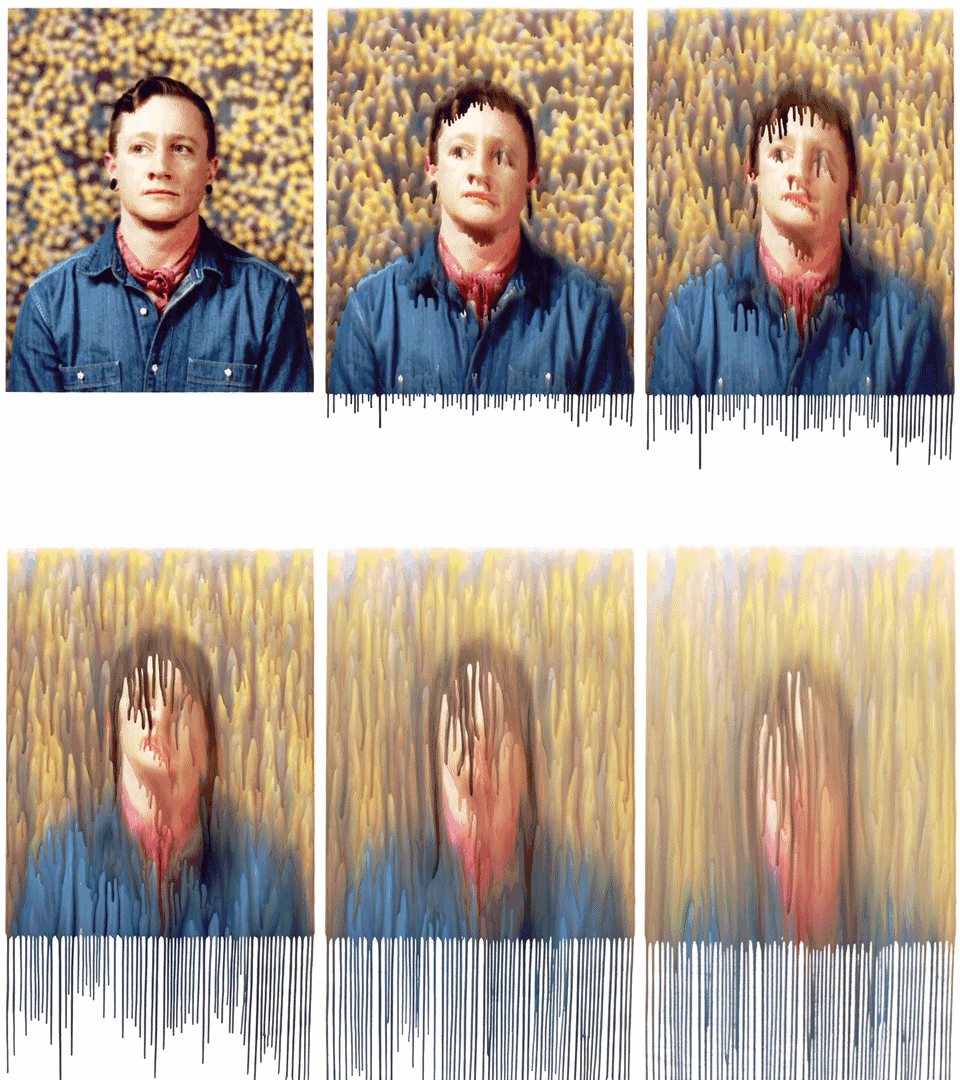
Mind-Boggling Melting Portraits

It's one thing to allow paint to streak and drip down a canvas, but photographer Ben DeHaan creates the same trickling technique with photographs for his series titled Uncured. The photographer's portraits in the mind-boggling series seem as though they are melting right before your very eyes. How does he do it? It's actually created with an ordinary printer missing one key step.
Traditional printers treat the image they are reproducing onto paper with UV light, a process that allows UV sensitive inks (typically used in commercial digital printing) to dry instantaneously and avoid messy blots and smudges. DeHaan says, "When uncured, the ink remains toxic and fluid. I am exploring the use of these printers without their essential element, UV light, in what I like to think of as a new process – UV uncurable inkjet printing perhaps?"
The artist goes on to explain his process: "The images are printed uncured and flat, then positioned vertically allowing the ink to run. The images are not digitally manipulated but are rather representations of different moments during the process." What naturally occurs to the portraits when sat upright is like an unfortunate mutation, which can be seen in these gifs. More from this series can be seen on DeHaan's site where he also includes time lapsed videos for each piece.


Blur Lines Between Reality and Fiction


Inspired by the cinema, French photographer Victoria Audouard takes us on a little adventure in this photo series entitledMirrors. The portraits are reminiscent of Alice in Wonderland, where every adventure is a confusing whirl of complex ideas. Each fairytale setting features a young girl reflecting the landscape back towards the viewer through a rounded mirror. As she shields herself from the outside world, she seems consumed by an eerie loneliness.
The earthy palettes cover the composition in a gradient of color, producing a surreal and very flat background. Through digital manipulation, Audouard creates the fictional settings in which it is difficult to distinguish between reality and fiction. The blurry lack of depth behind the figures produce a confusing juxtaposition against the strong, crisp landscapes within the mirror.
The imaginative photographer says her ideas come from her dreams and nightmares. She says, "I'm most interested in the memory…the process of trying to remember the dreams. In French we say 'fixei,' meaning 'to freeze, to keep.' I'm always looking for the perfect memory, except I don't think that really exists. I want to keep my dreams, express my feelings in which words cannot easily express. Photography balances that, compensates."

Monday, July 1, 2013

Creates a Window to the Past


Hungarian artist and photographer Kerényi Zoltán compares images from the past to the present in his series titled Ablak a Múltra, translated as Window to the Past. The photographer takes images from Fortepan, a site with an online collection of amateur photos from 1900 through the 1990's, and overlays it onto his own images at the same location.The black and white images from the past explore both the differences and similarities over time.
Zoltán's intriguing series compares architecture, fashion, and automotive technology by meticulously aligning the monochromatic image against the modern day backdrop. We're given the chance to see that the seats in today's stadiums were once occupied by past generations, newly renovated buildings used to be rundown spaces, and walkways didn't always have protective railings. Ultimately, this process reveals the progressive changes made by the past lives that have inhabited the same streets, parks, and buildings we walk across and live on today.
Top photo: 1900 meets 2012

1927 meets 2013

1937 meets 2012

1978 meets 2012

1962 meets 2012

1953 meets 2012

1954 meets 2012

1939 meets 2011

1948 meets 2013

1945 meets 2013

1963 meets 2013

1968 meets 2012

Monday, June 24, 2013

Superbus Wubbo Ockels

The first Superbus prototype, designed by former astronaut Wubbo Ockels and his team, is loaded into a KLM cargo plane at Schiphol airport, Amsterdam. The Superbus prototype will be presented in Dubai at the International Association of Public Transport exhibition. The electric Superbus is said to reach a speed of up to 250 kilometres per hour with up to 23 people on board.

The first Superbus prototype, designed by former astronaut Wubbo Ockels and his team, is loaded into a KLM cargo plane at Schiphol airport, Amsterdam. The Superbus prototype will be presented in Dubai at the International Association of Public Transport exhibition. The electric Superbus is said to reach a speed of up to 250 kilometres per hour with up to 23 people on board. 

The first Superbus prototype, designed by former astronaut Wubbo Ockels and his team, is loaded into a KLM cargo plane at Schiphol airport, Amsterdam. The Superbus prototype will be presented in Dubai at the International Association of Public Transport exhibition. The electric Superbus is said to reach a speed of up to 250 kilometres per hour with up to 23 people on board.

The first Superbus prototype, designed by former astronaut Wubbo Ockels and his team, is loaded into a KLM cargo plane at Schiphol airport, Amsterdam. The Superbus prototype will be presented in Dubai at the International Association of Public Transport exhibition. The electric Superbus is said to reach a speed of up to 250 kilometres per hour with up to 23 people on board.

The first Superbus prototype, designed by former astronaut Wubbo Ockels and his team, is loaded into a KLM cargo plane at Schiphol airport, Amsterdam. The Superbus prototype will be presented in Dubai at the International Association of Public Transport exhibition. The electric Superbus is said to reach a speed of up to 250 kilometres per hour with up to 23 people on board.

The first Superbus prototype, designed by former astronaut Wubbo Ockels and his team, is loaded into a KLM cargo plane at Schiphol airport, Amsterdam. The Superbus prototype will be presented in Dubai at the International Association of Public Transport exhibition. The electric Superbus is said to reach a speed of up to 250 kilometres per hour with up to 23 people on board.

The first Superbus prototype, designed by former astronaut Wubbo Ockels and his team, is loaded into a KLM cargo plane at Schiphol airport, Amsterdam. The Superbus prototype will be presented in Dubai at the International Association of Public Transport exhibition. The electric Superbus is said to reach a speed of up to 250 kilometres per hour with up to 23 people on board.

The first Superbus prototype, designed by former astronaut Wubbo Ockels and his team, is loaded into a KLM cargo plane at Schiphol airport, Amsterdam. The Superbus prototype will be presented in Dubai at the International Association of Public Transport exhibition. The electric Superbus is said to reach a speed of up to 250 kilometres per hour with up to 23 people on board.

The first Superbus prototype, designed by former astronaut Wubbo Ockels and his team, is loaded into a KLM cargo plane at Schiphol airport, Amsterdam. The Superbus prototype will be presented in Dubai at the International Association of Public Transport exhibition. The electric Superbus is said to reach a speed of up to 250 kilometres per hour with up to 23 people on board.

The first Superbus prototype, designed by former astronaut Wubbo Ockels and his team, is loaded into a KLM cargo plane at Schiphol airport, Amsterdam. The Superbus prototype will be presented in Dubai at the International Association of Public Transport exhibition. The electric Superbus is said to reach a speed of up to 250 kilometres per hour with up to 23 people on board.
Photo — Link

The first Superbus prototype, designed by former astronaut Wubbo Ockels and his team, is loaded into a KLM cargo plane at Schiphol airport, Amsterdam. The Superbus prototype will be presented in Dubai at the International Association of Public Transport exhibition. The electric Superbus is said to reach a speed of up to 250 kilometres per hour with up to 23 people on board.

The first Superbus prototype, designed by former astronaut Wubbo Ockels and his team, is loaded into a KLM cargo plane at Schiphol airport, Amsterdam. The Superbus prototype will be presented in Dubai at the International Association of Public Transport exhibition. The electric Superbus is said to reach a speed of up to 250 kilometres per hour with up to 23 people on board.